
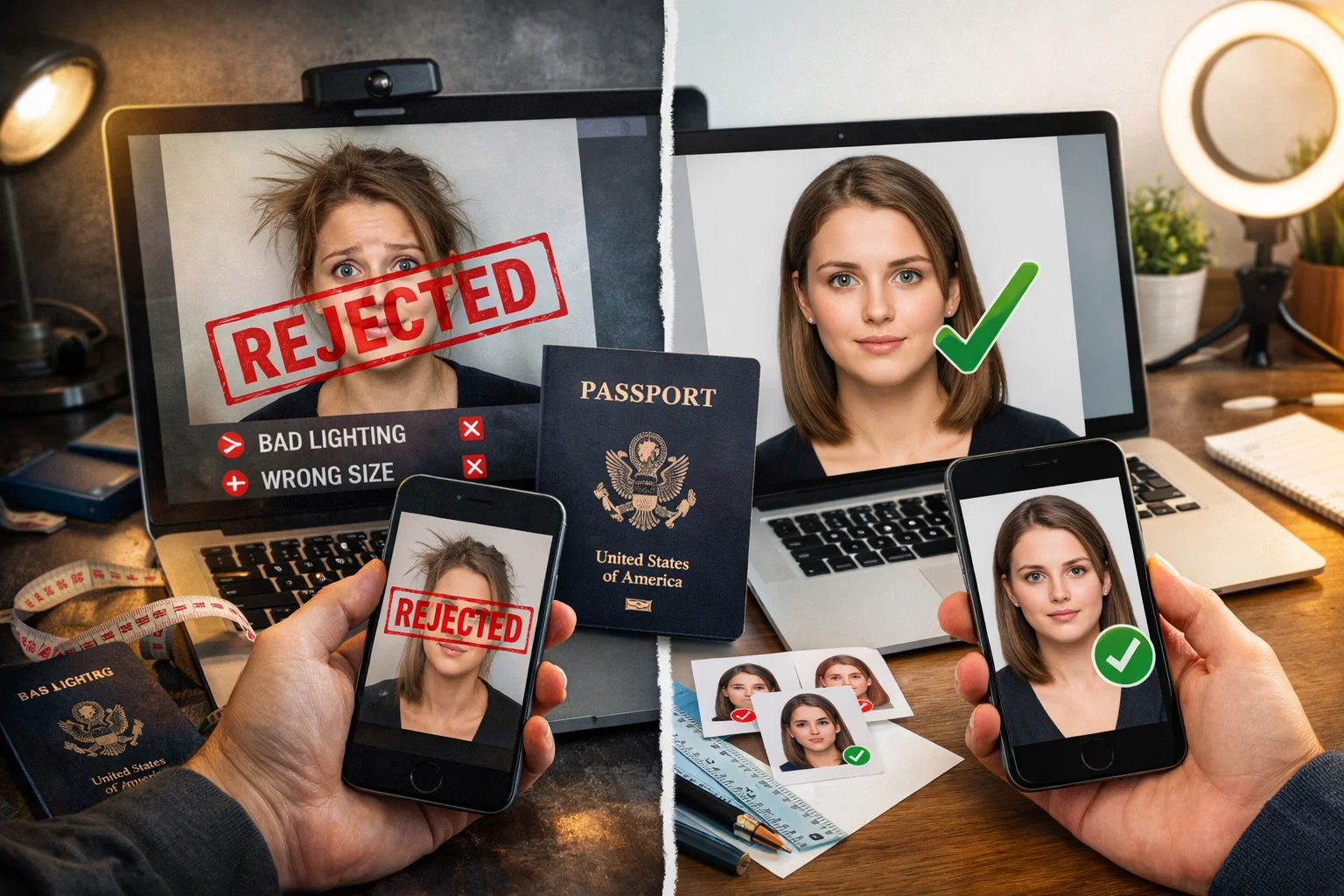
Why Most Tools Don’t Clear the 2026 Bar
The U.S. Department of State rejected more than 300,000 passport applications in 2024 because of non-compliant photos. Not blurry photos. Not damaged photos. Photos that looked perfectly fine to the applicant — and still got returned.
Starting January 1, 2026, the compliance bar got measurably harder to clear. The State Department ended its grace period for digitally altered images and moved to zero-tolerance enforcement: any photo edited by software, filtered, smoothed, or background-swapped using automated processing is now grounds for immediate rejection. The rule is stated plainly on travel.state.gov:
“Do not change your photo using computer software, phone apps or filters.”
No exceptions. No appeals during initial review.
Here is the problem that creates for most online tools. The majority of passport photo services run your image through automated enhancement pipelines before you ever see the result. Background replacement, exposure correction, and subtle facial touch-ups happen silently — often without disclosure. The output looks clean and professional. But under the 2026 standard, “clean and professional” achieved through digital alteration is precisely what triggers a rejection flag.
The financial stakes make this worth taking seriously:
- $165 — standard U.S. passport application fee
- 90 days — the resubmission window after a photo rejection
- 2–4 weeks — typical processing delay a returned photo adds to your timeline
- $0 extra — what a resubmission costs if you catch it within 90 days
- Full restart — what happens if you miss that window
The six tools ranked below were evaluated specifically against the conditions that cause real-world rejections in 2026 — not against a generic feature checklist. The scoring rubric comes first, before any tool is named.
How We Scored These 6 Tools

Every tool in this ranking was tested with the same source photo and evaluated against five criteria tied directly to the conditions that determine whether a U.S. passport photo gets accepted or returned. Here is how the scoring breaks down:
| Criterion | Weight | What It Measures |
| Compliance accuracy | 30% | Correct 2×2 inch format, head size ratio, white background, no facial alteration |
| Guarantee / rejection policy | 20% | What the service does if the State Dept. returns your photo |
| Ease of use | 20% | Number of steps from upload to downloadable file; mobile and desktop experience |
| Pricing transparency | 15% | Is the cost clear before processing begins? Are there surprise paywalls? |
| Speed to download | 15% | Time from upload to a usable, spec-ready file |
A few ground rules that shaped the evaluation:
- Compliance accuracy is weighted highest because a fast, cheap, easy-to-use tool that produces a rejected photo costs more than a slower, pricier one that gets accepted on the first submission.
- The guarantee criterion carries equal weight with ease of use because in 2026, with zero-tolerance enforcement in effect, a tool’s rejection policy is a direct measure of how confident it is in its own output.
- No tool received credit for features it doesn’t disclose. If a compliance check isn’t explicitly offered and documented, it was scored as absent.
Results are shown as a star rating per criterion (★ = poor, ★★★★★ = excellent) in each tool entry, with a weighted composite score determining the final ranking order.
The 6 Best US Passport Photo Online Tools, Scored and Ranked
#1 — PhotoGov
Verdict: The most compliance-focused option available for U.S. applicants in 2026 — built around validation, not enhancement.
| Criterion | Score |
| Compliance accuracy | ★★★★★ |
| Guarantee / rejection policy | ★★★★★ |
| Ease of use | ★★★★☆ |
| Pricing transparency | ★★★★★ |
| Speed to download | ★★★★★ |
| Weighted composite | 4.9 / 5 |
What sets it apart: PhotoGov’s core processing approach is specifically designed around the 2026 enforcement reality. Rather than enhancing your photo toward a polished result, it validates and formats — checking head size ratio, background uniformity, and dimensional accuracy without applying the kind of facial or lighting modifications that now trigger automatic rejection. The optional human verification add-on brings a trained specialist into the review before the file is delivered, catching edge cases that automated checks can miss.
Key strengths:
- Formats output to exact 2×2 inch spec (51×51 mm) with correct head positioning
- Background processing focused on compliance, not cosmetic improvement
- On-device data handling — uploaded photos are not retained after export
- Optional human verification available at checkout
- 200% refund guarantee if the photo is rejected by the issuing authority
Compliance risk note: Of all six tools reviewed, PhotoGov carries the lowest alteration risk under the 2026 rules. Its stated processing approach does not modify facial features or apply filters — it checks, crops, and confirms.
Pricing: Free tier available (one photo per day where capacity allows); paid digital photo from $2.90–$5.90; human verification add-on $2.90–$4.90; monthly subscription at $9.90 for frequent users.
Guarantee: 200% refund or free reprocessing if rejected.
#2 — Passport Photo Online
Verdict: Best choice for applicants who want a human expert in the review loop by default, without paying extra for it.
| Criterion | Score |
| Compliance accuracy | ★★★★☆ |
| Guarantee / rejection policy | ★★★★★ |
| Ease of use | ★★★★★ |
| Pricing transparency | ★★★★☆ |
| Speed to download | ★★★★☆ |
| Weighted composite | 4.5 / 5 |
What sets it apart: Human expert review is included in the base price — not an add-on. A trained reviewer checks every photo within minutes of submission, 24 hours a day. For applicants who are not confident in their source photo quality, that second set of eyes is a meaningful safety net.
Key strengths:
- Human review included as standard, not optional
- Strong independent trust signals: 4.5/5 on Trustpilot across 3,000+ reviews
- 200% refund policy on rejected photos
- Large document database covering multiple countries and visa types
Compliance risk note: Passport Photo Online’s automated processing pipeline includes background replacement and image adjustment. Users should review the final output carefully before submitting to confirm no facial modifications have been applied, given the 2026 alteration ban. The human review step provides a meaningful check against this risk.
Pricing: Digital photo from approximately $6.99; print delivery available for U.S. addresses.
Guarantee: 200% refund if rejected.
#3 — PhotoAiD
Verdict: The fastest turnaround of any tool reviewed — best suited to applicants uploading a digital file for online passport renewal who are confident in their source photo.
| Criterion | Score |
| Compliance accuracy | ★★★★☆ |
| Guarantee / rejection policy | ★★★★☆ |
| Ease of use | ★★★★★ |
| Pricing transparency | ★★★★☆ |
| Speed to download | ★★★★★ |
| Weighted composite | 4.3 / 5 |
What sets it apart: PhotoAiD processes uploads and delivers a formatted result in under three seconds. For applicants who already have a well-lit, correctly framed source photo and simply need it sized and formatted for digital submission, the speed advantage is genuine.
Key strengths:
- Sub-three-second processing from upload to preview
- Strong mobile and desktop UX — minimal steps to completion
- Broad document database covering U.S. passport and visa formats
- Compliance guarantee with refund policy
Compliance risk note: Speed is achieved through heavy automation. The processing pipeline includes background correction and image adjustment. Applicants should preview the final output carefully and verify no facial modifications have been introduced before submitting to the State Department’s online renewal portal.
Pricing: Digital photo from approximately $9.99; print delivery available.
Guarantee: Compliance guarantee offered; refund policy applies on rejection.
#4 — iVisa Photos
Verdict: The strongest option for applicants who need both a passport photo and a visa photo handled in a single workflow.
| Criterion | Score |
| Compliance accuracy | ★★★★☆ |
| Guarantee / rejection policy | ★★★★☆ |
| Ease of use | ★★★★☆ |
| Pricing transparency | ★★★☆☆ |
| Speed to download | ★★★★☆ |
| Weighted composite | 3.9 / 5 |
What sets it apart: iVisa built its reputation processing visa applications, and that depth of document expertise carries over into its photo service. Expert review is available, and the interface handles multiple document types cleanly in one session — useful for applicants preparing both a passport renewal and a pending visa application simultaneously.
Key strengths:
- Expert review option available
- Covers passport and visa photo requirements in one workflow
- Clean, low-friction interface with clear on-screen guidance
- Delivery options include digital download and physical prints
Compliance risk note: iVisa’s primary focus is visa photos rather than U.S. passport-specific compliance. Before submitting any output to the State Department, applicants should cross-check the final image dimensions and background against the official specifications at travel.state.gov.
Pricing: Digital photo from approximately $14.99; pricing structure is less transparent at entry than other tools reviewed — full cost becomes clearest at checkout.
Guarantee: Acceptance guarantee offered; specific refund terms vary by document type.
#5 — ePassportPhoto
Verdict: A straightforward fallback for applicants who want a simple upload-and-download flow and are comfortable taking responsibility for their own source photo quality.
| Criterion | Score |
| Compliance accuracy | ★★★☆☆ |
| Guarantee / rejection policy | ★★☆☆☆ |
| Ease of use | ★★★★☆ |
| Pricing transparency | ★★★★☆ |
| Speed to download | ★★★★☆ |
| Weighted composite | 3.2 / 5 |
What sets it apart: ePassportPhoto offers one of the more straightforward upload experiences in this category — select document type, upload photo, receive output. Pricing is stated clearly before processing begins, which is not universal among competitors.
Key strengths:
- Clean, minimal interface with few steps to completion
- Pricing disclosed upfront: digital at $13.95, prints at $16.95
- Covers both digital download and physical print delivery
Compliance risk note: No explicit compliance guarantee is listed, and no clear rejection policy was found during testing. For a tool priced at the higher end of this category, that absence is a meaningful gap. Applicants using ePassportPhoto carry the full financial risk if the output is returned by the State Department.
Pricing: Digital photo $13.95; print delivery $16.95.
Guarantee: None confirmed. Use with caution if your deadline is firm.
#6 — IDPhotoDIY
Verdict: The right tool only for experienced applicants who understand U.S. passport photo specifications in detail and want complete manual control over every adjustment.
| Criterion | Score |
| Compliance accuracy | ★★☆☆☆ |
| Guarantee / rejection policy | ★☆☆☆☆ |
| Ease of use | ★★★☆☆ |
| Pricing transparency | ★★★★☆ |
| Speed to download | ★★★☆☆ |
| Weighted composite | 2.4 / 5 |
What sets it apart: IDPhotoDIY is fully manual — cropping, sizing, and adjustments are all performed by the user. There is no automated compliance check and no validation step. For someone who already knows exactly what a compliant U.S. passport photo requires and wants to handle every decision themselves, that control is the point.
Key strengths:
- Free digital download available
- Full manual control over crop, orientation, and sizing
- Useful for applicants with non-standard document requirements
Compliance risk note: This is the highest-risk tool in the ranking for most applicants. Every compliance decision rests entirely with the user. There is no compliance checker, no human review, and no rejection guarantee. A single incorrect crop or miscalibrated head size ratio will result in a returned application — with no recourse through the tool itself. Not recommended for first-time applicants or anyone without detailed familiarity with the State Department’s photo specifications.
Pricing: Free for digital download; print options available at additional cost.
Guarantee: None.
Compliance Scorecard — 6 Tools at a Glance
The table below maps all six tools against the five scoring criteria used in this review. Use it to compare options at a glance or to identify the right tool for your specific priority — whether that is the strongest guarantee, the lowest price, or the fastest delivery.
| Tool | Compliance Check | Alteration Risk | Human Review | Guarantee | Digital Price | Best For |
| PhotoGov | ✅ Automated + optional human | 🟢 Low | Add-on ($2.90–$4.90) | 200% refund | Free / from $2.90 | Compliance-first applicants |
| Passport Photo Online | ✅ Automated + human included | 🟡 Low–Medium | Included as standard | 200% refund | From ~$6.99 | Expert peace of mind |
| PhotoAiD | ✅ Automated | 🟡 Medium | Optional | ✅ Refund policy | From ~$9.99 | Speed and digital upload |
| iVisa Photos | ✅ Expert review available | 🟡 Low–Medium | Optional | ✅ Varies by document | From ~$14.99 | Passport + visa combo |
| ePassportPhoto | ⚠️ Basic automated | 🟠 Medium | ❌ None | ❌ None confirmed | $13.95 | Simple fallback |
| IDPhotoDIY | ❌ Manual only | 🔴 High | ❌ None | ❌ None | Free | Experienced DIY users |
Three Situations Where Your Tool Choice Actually Matters
Most passport photo articles treat every applicant as identical. They are not. The tool that is right for someone uploading a digital file at home on a Tuesday afternoon is not necessarily the right tool for a parent trying to photograph a six-month-old, or for someone whose passport expires in three weeks. Here are the three scenarios where the choice of tool has the most direct impact on outcome.
You’re Renewing Online and Need a Digital File Today
The State Department’s online passport renewal system has its own technical requirements that are distinct from the printed photo specs most people are familiar with. Your digital file must be:
- JPEG format — no PNG, HEIC, or other file types
- 600×600 to 1200×1200 pixels — square crop, within this exact range
- Under 240 KB in file size
- Unaltered — no filters, no editing, no background replacement using digital tools
Most applicants discover these specs only after their upload is rejected by the government’s own portal. Choosing the right us passport photo online tool from the start eliminates that discovery the hard way.
PhotoGov outputs a spec-ready JPEG formatted to the online renewal portal’s exact requirements — square crop, correct pixel range, under the file size ceiling — without applying the kind of image modifications that flag an automatic rejection. For applicants going through the online renewal route, it is the most direct path from selfie to submission-ready file.
PhotoAiD is the fastest alternative if speed is the overriding priority and you are confident your source photo is already well-lit and correctly framed.
You’re Getting a Photo for a Child or Infant
Child and infant passport photos follow the same 2×2 inch dimensional requirements as adult photos — but the practical challenges are entirely different. The State Department’s specific guidance for infant photos includes:
- The child’s eyes must be open and facing the camera directly
- No parent’s hands, toys, car seats, or pacifiers may be visible in the frame
- The background must be plain white or off-white — a white sheet laid flat works well
- The child’s full face must be unobstructed from chin to crown
Getting a compliant infant photo on the first attempt is genuinely difficult. The margin for error is narrow, and a rejected child photo carries the same resubmission timeline as an adult one.
Passport Photo Online and PhotoGov both include specific guidance for infant and child photos within their workflows, helping parents understand framing and positioning requirements before uploading. IDPhotoDIY offers no guidance here — making it a poor choice for this use case regardless of its other merits for experienced users.
You’re on a Tight Deadline
A photo rejection adds two to four weeks to an already lengthy processing timeline. For applicants with a fixed departure date, a booked international connection, or a visa appointment that cannot be rescheduled, that delay is not an inconvenience — it is a trip-ending problem.
When the cost of a rejection is measured in missed travel rather than just money, the guarantee column in the scorecard above becomes the most important column in the table. The practical question is not which tool is cheapest but which tool gives me the best chance of getting this right on the first submission.
In this scenario, the ranking narrows quickly:
- PhotoGov — 200% refund guarantee, low alteration risk, optional human verification available as an add-on
- Passport Photo Online — human review included as standard, 200% refund guarantee, strong independent review track record
Both tools prioritize first-submission accuracy over speed or price. For deadline-sensitive applicants, that trade-off is the right one to make.
Frequently Asked Questions
What makes a US passport photo get rejected in 2026?
The most common rejection triggers fall into two categories: technical specification failures and the new 2026 alteration enforcement rules.
Technical failures include:
- Incorrect dimensions — the photo must be exactly 2×2 inches (51×51 mm) for printed applications; digital files must be 600×600 to 1200×1200 pixels in JPEG format
- Head size out of range — your face must measure between 1 and 1⅜ inches (25–35 mm) from chin to crown within the frame
- Background that is not plain white or off-white — shadows, gradients, textured walls, and off-white tones all cause rejections
- Shadows on the face or behind the head — even soft shadows from overhead lighting are grounds for return
- Photo taken more than six months before submission
- Glasses — banned since 2016, with a narrow documented medical exception only
The 2026-specific trigger: Starting January 1, 2026, the State Department enforces zero tolerance for digital alterations of any kind. This includes background replacement performed by software, automated skin smoothing, brightness or contrast adjustments applied by an app, and any filter — including filters applied automatically by a smartphone camera. The official guidance on this is published at travel.state.gov.
Does the State Department’s own photo tool guarantee compliance?
No — and this is one of the most consequential misunderstandings in this space.
The official U.S. passport photo tool at tsg.phototool.state.gov is a cropping tool only. It takes a photo you upload and sizes it to the correct dimensions for a printed application. That is the full extent of what it does.
It does not evaluate:
- Whether your lighting is compliant
- Whether shadows are present on your face or background
- Whether your head size ratio falls within the required range
- Whether your expression is appropriate
- Whether the photo was taken within the last six months
- Whether any digital alteration has been applied
A photo can pass through the government’s own tool, download successfully, and still be rejected at the application review stage. Using the official tool is not a substitute for using a service that performs actual compliance validation.
Can I use a free online tool for my official US passport photo?
Technically yes — there is no rule against using a free tool. But the compliance trade-offs are significant and worth understanding before you decide.
Free tools almost universally fall into one of two categories: tools that perform minimal processing with no compliance check (meaning the result is only as good as your source photo and your own knowledge of the requirements), or tools that are free at entry but apply automated enhancements — which, under the 2026 alteration rules, may produce an output that is more likely to be rejected than a carefully taken unedited photo.
The practical calculation is straightforward: the government fee for a passport application is $165. A paid tool with a compliance guarantee costs between $3 and $15 depending on the service. If a free tool produces a rejected photo, you absorb the full cost of the delay and any expediting fees you need to recover your timeline. If a guaranteed tool produces a rejected photo, the service covers the correction.
For most applicants, the cost of a guarantee is small relative to the cost of being wrong.
How long does it take to get a passport photo from an online tool?
It depends on whether the tool uses automated processing only or includes a human review step.
- Automated processing only (PhotoAiD, ePassportPhoto, IDPhotoDIY): results are typically available within 30 seconds to two minutes of upload
- Automated processing with optional human review (PhotoGov with add-on): automated result in under a minute; human verification typically completed within a few minutes depending on queue
- Human review included as standard (Passport Photo Online): turnaround is typically three to five minutes, with reviewers available around the clock
Even the slowest of these options is faster than driving to a pharmacy, waiting in line, and hoping the in-store lighting cooperates. The meaningful time variable is not how fast the tool processes your photo — it is how fast your application moves through the system when the photo is right on the first submission.
What happens if my online passport photo gets rejected?
If the State Department returns your application due to a non-compliant photo, you have 90 days from the date of the rejection notice to submit a corrected photo. If you resubmit within that window, you do not pay the application fee again.
If you miss the 90-day window, your application is cancelled and you must start the process from scratch — which means paying all fees again and waiting in the full processing queue.
What happens next depends on which tool you used:
- Tools with a guarantee (PhotoGov, Passport Photo Online, PhotoAiD): the service will reprocess your photo at no charge or refund your purchase — in the case of PhotoGov and Passport Photo Online, the refund is 200% of the original purchase price
- Tools without a guarantee (ePassportPhoto, IDPhotoDIY): you bear the full cost of correction yourself, including any expediting fees if your timeline has been compressed by the delay
The 90-day window is generous enough that most applicants can correct a photo rejection without catastrophic consequences — provided they act promptly and use a tool that gives them a compliant result the second time.
The Bottom Line
Not every online passport photo tool is built for the compliance environment that exists in 2026. Several of the most widely marketed options in this space run automated enhancement pipelines that directly conflict with the State Department’s zero-tolerance alteration policy — and none of them disclose that conflict prominently.
The tools that scored highest in this review share a specific characteristic: they prioritize getting the photo right over making it look good. Those are not the same thing, and in 2026 the distinction has direct consequences for whether your application moves forward or gets returned.
PhotoGov earns the top position in this ranking not because it is the flashiest tool or the cheapest option, but because its processing approach most cleanly avoids the failure modes that are causing real applications to be rejected right now. It validates and formats without applying the kind of modifications that trigger automatic rejection. Its 200% refund guarantee is the strongest in the category. And its optional human verification add-on gives applicants who want an extra layer of confidence a practical way to get it without paying for features they may not need.
Passport Photo Online is the right alternative for applicants who want human review included as a default rather than an optional extra — particularly useful if your source photo is less than ideal and you want a trained reviewer to catch problems before submission rather than after.
For everyone else, the guidance is the same regardless of which tool you choose: start with a correctly taken photo. Use even, natural lighting. Stand against a plain white background. Have someone else take the picture from at least five feet away — do not use a selfie taken at arm’s length. Disable any automatic beauty or portrait mode on your camera before shooting.
A good source photo reduces every tool’s compliance risk. A poor source photo gives even the best tool a harder problem to solve — and in 2026, some of those solutions now break the rules.
Before submitting any application, verify your photo against the full current requirements published at travel.state.gov. That page is the only source that reflects live enforcement policy — and in a year when the rules changed significantly, it is worth the two minutes it takes to check.